The Top 10 Cal/OSHA Violations in Agriculture: Part 2 – Your Injury and Illness Prevention Program (IIPP)
If Heat Illness Prevention is one of Cal/OSHA’s highest enforcement priorities, then the Injury and Illness Prevention Program (IIPP) is the foundation that supports it.
In fact, nearly every Cal/OSHA inspection begins with one question:
“Can I see your Injury and Illness Prevention Program?”
For many employers, the answer is simple—they hand the inspector a binder. But having a written plan is only the beginning. What Cal/OSHA is really evaluating is whether that plan is being implemented every day.
A Brief History
California was the first state in the nation to require every employer to establish a written Injury and Illness Prevention Program. The regulation, found in Title 8, Section 3203, became effective on July 1, 1991, following amendments to California’s occupational safety laws that shifted the focus from responding to workplace injuries to preventing them before they occur.
The philosophy behind the IIPP is simple:
A safe workplace doesn’t happen by accident. It requires planning, communication, training, inspections, and continual improvement.
More than thirty years later, that philosophy remains at the heart of every Cal/OSHA inspection.
What Does an IIPP Require?
Section 3203 requires every California employer to establish, implement, and maintain an effective written Injury and Illness Prevention Program.
An effective IIPP contains eight essential elements:
- Assign responsibility for workplace safety.
- Establish a system to ensure employees follow safe work practices.
- Communicate safety information in a manner employees understand.
- Conduct scheduled workplace inspections to identify hazards.
- Investigate workplace injuries and near misses.
- Correct unsafe conditions in a timely manner.
- Train employees and supervisors whenever hazards exist or job duties change.
- Maintain required records and documentation.
Notice that only one of these elements is simply “having a written program.” The remaining elements require employers to actively manage safety throughout the year.
Where Employers Get into Trouble
One of the most common misconceptions is that an IIPP is complete once it’s written.
In reality, many citations occur because employers fail to implement the plan they already have.
During inspections, Cal/OSHA frequently identifies issues such as:
- An outdated IIPP that doesn’t reflect current operations.
- Safety inspections that are required by the plan but never conducted.
- Hazards identified during inspections but never corrected.
- New employees who were never trained.
- Supervisors who are unfamiliar with their safety responsibilities.
- Missing documentation showing that inspections, training, or corrective actions occurred.
- Employees who are unaware of how to report hazards or safety concerns.
An ineffective IIPP often becomes the “gateway” citation during an inspection. If inspectors discover deficiencies in machine guarding, heat illness prevention, lockout/tagout, hazard communication, or respiratory protection, they frequently determine those hazards should have been identified and corrected through the employer’s Injury and Illness Prevention Program.
In other words, when the IIPP isn’t working, other violations often follow.
Safety Doesn’t Take Fridays Off
One of the most valuable aspects of FELS is that our Labor Management Consultants don’t just understand the regulations—they’ve seen firsthand what happens when safety procedures aren’t followed.
Gilbert Altamirano, one of FELS’ Labor Management Consultants, has worked with agricultural employers who have experienced the unimaginable: a workplace fatality.
“What struck me,” Gilbert recalls, “was that in both cases, the incidents happened on a Friday afternoon.”
During discussions with investigators, Gilbert was told something that has stayed with him ever since. They often see an increase in serious incidents toward the end of the workweek, when employees—and sometimes supervisors—are eager to finish the day and head home.
“When people are rushing to get home for the weekend,” Gilbert said, “they’re more likely to take shortcuts. Unfortunately, that’s when people get hurt.”
Gilbert shared a Spanish saying that perfectly captures this mindset:
“Es viernes y el cuerpo lo sabe.”
Loosely translated, it means:
“It’s Friday, and your body knows it.”
By Friday afternoon, it’s easy for minds to wander toward weekend plans. Fatigue sets in. Attention slips. Small shortcuts become tempting.
An effective Injury and Illness Prevention Program is designed to combat exactly that. Regular safety meetings, supervisor engagement, hazard recognition, and accountability help ensure that every employee remains focused—not just on Monday morning, but throughout the entire workweek.
Whether it’s Monday at sunrise or Friday at quitting time, every employee deserves to go home safely.
As Gilbert often reminds his clients:
“Don’t relax into Friday mode until the workday is over.”
The Cost of Non-Compliance
Beginning in 2025, Cal/OSHA’s maximum penalties increased to:
- $16,285 for a general or regulatory violation.
- $25,000 for a serious violation.
- $162,851 for each willful or repeat violation.
An IIPP citation is rarely the only citation issued during an inspection. Instead, it often accompanies other violations because inspectors conclude that an effective safety management system would have identified and corrected the hazards before someone was injured.
Recognizing the importance of the IIPP, Cal/OSHA has also strengthened its inspection process. Inspectors are now expected to evaluate each of the program’s eight required elements during inspections, rather than simply confirming that a written plan exists.
Is Your IIPP Working?
A good question for every agricultural employer is this:
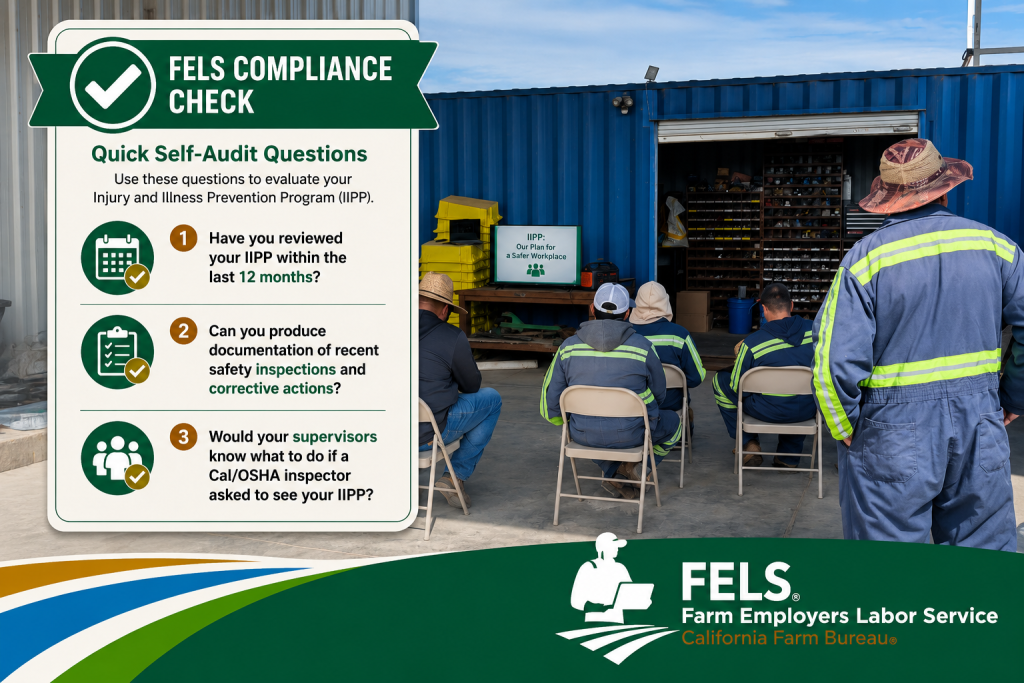
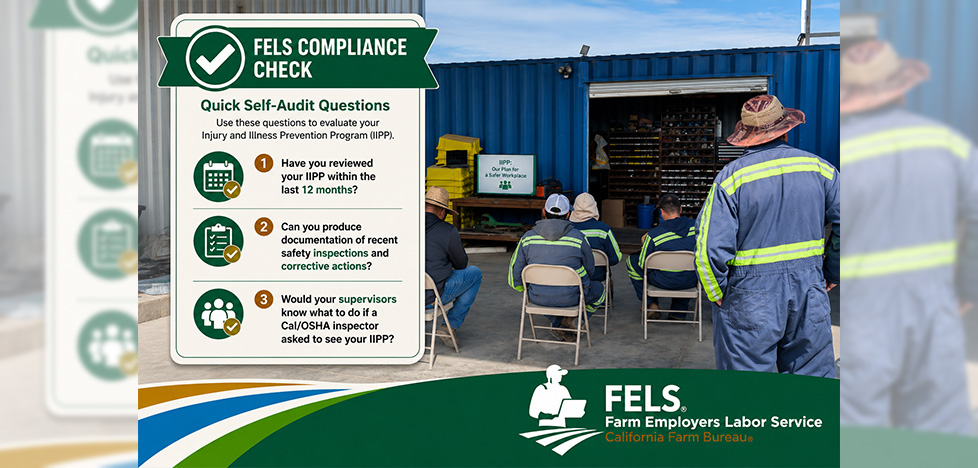
If Cal/OSHA arrived today, could your supervisors explain how your IIPP works?
Could employees describe how they report hazards?
Could you produce recent inspection records, training documentation, and evidence that identified hazards were corrected?
If the answer to any of those questions is “I’m not sure,” your IIPP may need more than an annual review.
How FELS Can Help
At FELS, we understand that every farming operation is different. A generic safety binder downloaded from the internet won’t necessarily reflect your employees, equipment, or operations.
Our Labor Management Consultants can help you:
- Develop a customized Injury and Illness Prevention Program that meets Cal/OSHA requirements.
- Review and update your existing IIPP to ensure it reflects your current operation.
- Train supervisors and employees on their responsibilities under the program.
- Conduct on-site safety reviews to identify compliance gaps before Cal/OSHA does.
- Help implement the procedures that turn your IIPP from a written document into an effective safety management system.
Remember, the goal of an IIPP isn’t simply to satisfy a regulation—it’s to create a culture where hazards are identified, corrected, and communicated before someone gets hurt.
In next month’s edition of our Top 10 Cal/OSHA Violations in Agriculture series, we’ll take a closer look at another frequently cited standard and discuss practical ways to keep your operation compliant while protecting your most asset—your employees.